This morning, we enjoyed a buffet-style breakfast at the
hotel before driving about 45 minutes into Yamamoto Village. We headed to Yamashita Elementary School to tour the
school and to learn about the unique situation in this school. Yamashita
Elementary School used to have about 200 students, but now there are
approximately 320 students learning at the school, as the students from Yamashita #2 School are also learning
here, renting rooms in the school, but serving as an entirely different school.
When we arrived at the school, there were several students
at the entrance to the building, greeting us with smiles and laughter.
Several
pairs of leather slippers lined the first step to the school, and we quickly
took off our shoes and put on the slippers. We were then directed to the
principal's office for tea and a brief overview of the school. Following that,
we began to tour the school.
We started our tour in a first grade classroom, where children were in
the middle of a writing lesson. Students would raise their hands quickly after each question, and would stand to answer the teacher. They were very focused on their
work and their teacher, each sitting on a little pillow at their wooden desks.
In the second grade classroom next door, students were
working on math, creating geometric shapes in their workbooks.
 |
Mikiko, our translator and a local news
reporter, shows us a student backpack,
which is used from 1st grade through 9th
grade, and costs about $900. |
Third grade was completing a science lesson on circuits and
electricity, and the kids were thrilled to create machines that made discs fly
through the air.
As we walked down the hallway towards the music room, a
group of older kids came out of the room with tires that were covered with
plastic (tape?) and wooden sticks. Yes, they were drums! We went into the
gymnasium to watch, listen, and play a bit on the drums. The kids were great
and looked like they were having a lot of fun too!
After our tour of the classrooms, we headed back to the
principal's office for lunch. Curry over rice, a salad with edamame, ham, and
red peppers, and a hard-boiled egg with a bottle of water, carton of milk, and
cup of tea was quickly eaten so that we could observe the kids serving and
eating lunch, a time called Kyushoku in Japanese.
The kids in Japanese schools are responsible for preparing
their meals and cleaning up after themselves. Watching the little first graders
with their hats, masks, aprons, and gloves was incredible. They kids served one
another, and even returned food to the main serving dishes prior to eating in
the event they were given too much food. The kids waited until all of their
classmates were served, and a little girl in front of the class reminded the kids,
“let’s eat”, as is traditionally said before a meal in Japan.
 |
| Getting the dishes ready. |
 |
| Bringing in the food. |
 |
| Peeling hard-boiled eggs could have kept the kids busy the entire lunch period! |
 |
| The uniform goes home each night to be washed! |
 |
| Brushing your teeth after lunch is required. |
Walking into a third grade room, we enjoyed chatting with
the kids while they ate, and listening to the student-led announcements about
the nutritional values of the meal the kids were eating.
The kids in the school look like kids in our school,
laughing, talking, and having fun while they learned. They do not take classes with the Yamashita Elementary
students, even though they learn under the same roof. We met with the principal
of Yamashita #2 School, Mr. Watanabe, for tea as we learned their story.
 |
I noticed this clock in the office, stopped at 2:46,
the time the earthquake hit Yamamoto. |
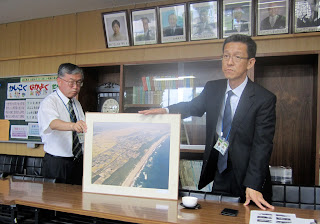
In 2011, Yamashita #2 School was about 23 years old, with
approximately 220 students, 9 classes, and 20 teachers. It was a beautiful
building among many houses and forests of pine trees, along the ocean, but
protected by a 6 meter tall wall, preventing the view of the ocean from the school.
 |
The black tsunami waves almost reached the
second floor of the school. |
On March 11, 2011, the Tohoku region of Japan experienced
the 9.0 magnitude earthquake and ensuing tsunami, and the village of Yamamoto
(population 14,000 before the tsunami) was unrecognizable. School usually ended
at around 3:00 pm, but the earthquake struck at 2:46 pm, while over 90% of
students were in attendance. The school evacuated to the field after the
earthquake, and when people came up towards the school, yelling about a tsunami
coming, teachers filled their cars with students and took them to City Hall, which was on higher ground. Mr. Watanabe decided to stay behind to inform parents where
the children were, moving to the second floor of the building for safety. There,
within forty minutes, at 3:19 pm, he watched as wave after wave hit the school, something
they never imagined would happen, despite the tsunami evacuation drills they
had.
 |
The clocks in the building are all stopped at 3:19 pm.
|
Mr. Watanabe is a smart man, and realizing the possibility of drowning, he cleared the books from a library shelf on the second floor, and pulled the shelf off the wall to use as a boat, if needed. As he waited to be rescued that cold, snowy day and evening, he wrapped himself in curtains to keep warm. And though he didn’t share this entire story with us (the Superintendent of the Board of Education did), I don’t think I’ll forget this man’s face or his story.
 |
The library bookshelves that Mr. Watanabe decided could be
used as a boat. |
 |
| Mr. Watanabe put the "boat" out here, but was rescued here by helicopter on March 12th. |
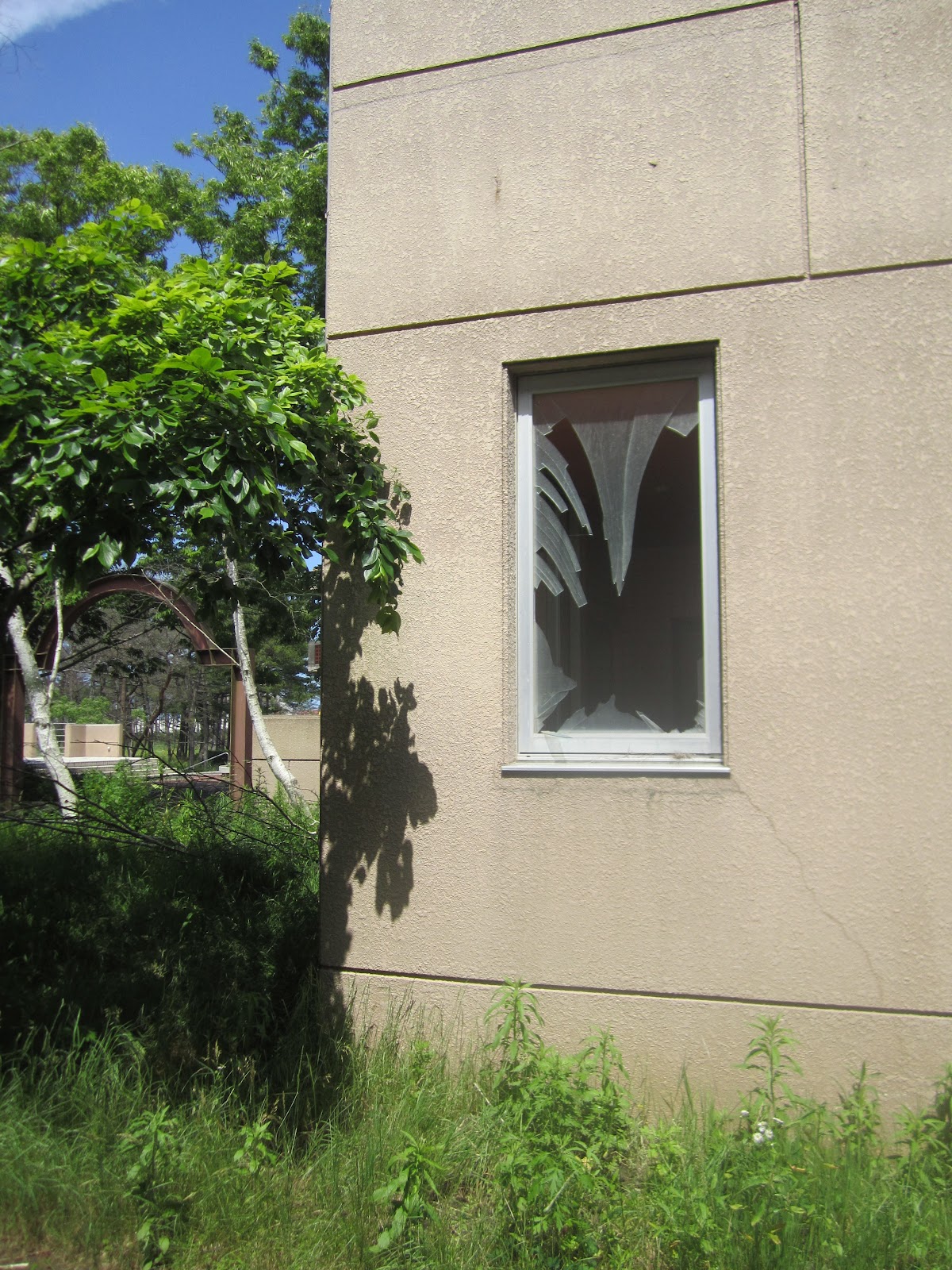
The school was destroyed, windows shattered, beams bent and wires hanging, the wooden floorboards saturated and bending.
 |
| Children's boot racks used to be here. |
 |
| The government quickly cleaned the debris out of many buildings, and mounds and mounds of it pile up along the remaining roadways. |
 |
| Evidence of learning that was occurring just before the earthquake and tsunami on March 11, 2011. |
 |
| At the entrance of the building, the statue remains. |
One child from the school was killed throughout the earthquake and evacuation process. Her parents picked her up from City Hall before the tsunami struck, and their car and the family was washed away.
Most families lost their homes, and a school that once had over 220 students now has 126 students. The school may never be rebuilt, as the government will not allow anyone to move back into the area or rebuild at the current time. Most families live in temporary housing, and students walk 15 minutes to the Yamishita Elementary School building. The town of Yamamoto now has a population of under 10,000 people.
When
presenting our gift to Mr. Watanabe I told him that we know being a principal is
a difficult job, and that we understood that his position was even more
difficult than we could imagine. I told him that we believe he was brave and
courageous, and that he is a hero.